
In June 2026, the Science-Based Targets initiative (SBTi) released Version 2.0 of its corporate target-setting standard. The new version, effective February 2027, introduces significant changes to how companies set, implement, and track progress toward science-based climate targets.
The updated standard moves beyond target-setting to place greater emphasis on implementation, governance, and measurable progress. It also introduces more tailored approaches based on company size and geography, new methodologies for setting emissions targets, and a framework for taking responsibility for ongoing emissions.
Here’s what companies need to know about the changes and how to prepare for the next target-setting cycle.
Key Changes Under SBTi V2.0 And What It Means for Your Organization
- New Categorizations Introduced Based on Company Size and Geography
SBTi V2.0 introduces two company categories, Category A and Category B, with different requirements based on factors including company size, financial thresholds, and geographic considerations. With this structure, companies with higher headcounts, higher sales and assets, and in historically high-emitting countries now face more stringent requirements for target-setting.
The goal is to provide smaller companies (Category B) a more flexible pathway to setting science-based targets while keeping those with more historical resources (Category A) accountable to being target-setting leaders.
| Category A | Category B |
|---|---|
|
Net turnover ≥ €450M or FTE ≥ 1,000 from ANY country OR Scope 1 and 2 emissions ≥ 10,000 tCO₂e or at least two of the following from high-income countries*:
|
Any other company not meeting the Category A criteria |
*High-income countries are determined by the World Bank economic income categories.
What it means for you: Determine which category your company will fall in prior to setting targets. Most medium-to-large companies based in the US, EU, or parts of Asia will fall under category A, which requires Scope 3 targets, assurance, transition plan disclosures, and long-term additional carbon removals. Not sure how target-setting requirements differ between Category A and Category B? Download our one-pager for side-by-side comparisons.
2. Climate Targets Will Require Leadership Sign-off and Transition Planning
The new standard strengthens the connection between climate targets and business strategy. While most important for Category A, all target-setting companies are expected to develop transition plans that outline how they intend to achieve their targets, supported by clear actions, accountability, and milestones.
Executive leadership approval of targets is also required. These changes aim to help companies move beyond setting targets on paper and establish a clearer path toward achieving them, reflecting the outcomes of companies setting targets whose senior leadership is not engaged.
What it means for you: Develop a transition plan covering planned activities to meet decarbonization goals in tandem with developing targets, ensuring leadership sign-off and organizational buy-in.
3. Scope 1 and Scope 2 Targets Will Be Set Separately
Under the previous version, companies were empowered to set joint scope 1 and 2 targets to reduce their operational footprint with one goal. However, V2.0 requires separate targets for each scope, giving companies a more specific way to address their direct emissions and purchased energy.
In doing so, SBTi introduced new methodologies for Scopes 1 and 2 to allow for companies in higher-emitting industries to account for location-based pathways toward decarbonization, using asset transition and low-carbon energy approaches to shift business to net-zero activities.
What it means for you: Review the new target-setting methodologies to determine whether your decarbonization goals might be well-suited to one of SBTi’s newer approaches. Companies in harder-to-abate industries may find this opens the door to emissions reductions planning that may have been less comparable under V1.3.1.
4. Scope 3 Is Shifting From Measurement To Action
Scope 3 emissions, which occur across a company’s value chain, can be challenging to reduce because they often depend on suppliers, customers, and other external stakeholders.
SBTi V2.0 introduces additional target-setting methodologies and implementation guidance to help companies link their validated targets to decarbonization roadmaps. These include greater flexibility in how companies account for different value-chain activities, along with approaches that support supplier engagement and targeted emissions reduction actions.
What it means for you: Assess your value chain data availability to understand which target-setting methodologies will be the best fit for your data, industry, and target-setting goals.
5. Companies Will Face Greater Expectations Around Progress Tracking
SBTi V2.0 reinforces the importance of monitoring progress after targets have been established. This includes providing companies with detailed implementation resources, recommendations for year-over-year reporting, and guidance on cases where operational footprint may require reassessment to make sure targets continue to reflect current business reality. During these reassessments, companies will be expected to publish annual progress, outlining actions taken toward goals as well as any barriers to progress, in addition to keeping a five-year horizon. At the end of each target cycle, which includes a full GHG inventory.
The goal is to shift emissions management from a one-off exercise to a repeatable process that tracks toward target achievement.
What it means for you: Utilize SBTi’s resources to ensure your company is staying on track to meet targets. Regular assessments can help your company understand whether decarbonization measures are delivering results and where adjustments may be needed.
6. V2.0 Establishes a New Approach to Ongoing Emissions
One of the significant additions in V2.0 is the Ongoing Emissions Responsibility (OER) recognition program, which is a new system for managing emissions that cannot otherwise be reduced.
The program is optional for companies through 2035 and mandatory for Category A companies thereafter. It allows companies to use market mechanisms to reduce emissions which cannot otherwise be curtailed, such as for companies who rely on activities which are directly linked to carbon output (e.g., cement, aviation).
The program does not replace decarbonization expectations but instead outlines ways to take responsibility for residual emissions after operational and value chain reductions, including carbon removal programs, investment in decarbonization technologies, and sector collaboration. Participating in this program allows companies to be recognized for positive climate actions in public and disclosures.
What it means for you: Evaluate how, over time, your climate strategy could extend beyond your own business impacts and company. Companies can take advantage of carbon credits, offsets, internal reduction investments, and green budgeting to support, but not replace, their decarbonization approach. Doing so may allow companies to be recognized under different commendation tiers subject to the scale of their emissions reduction or removal activities.
SBTi V2.0 Transition Timelines
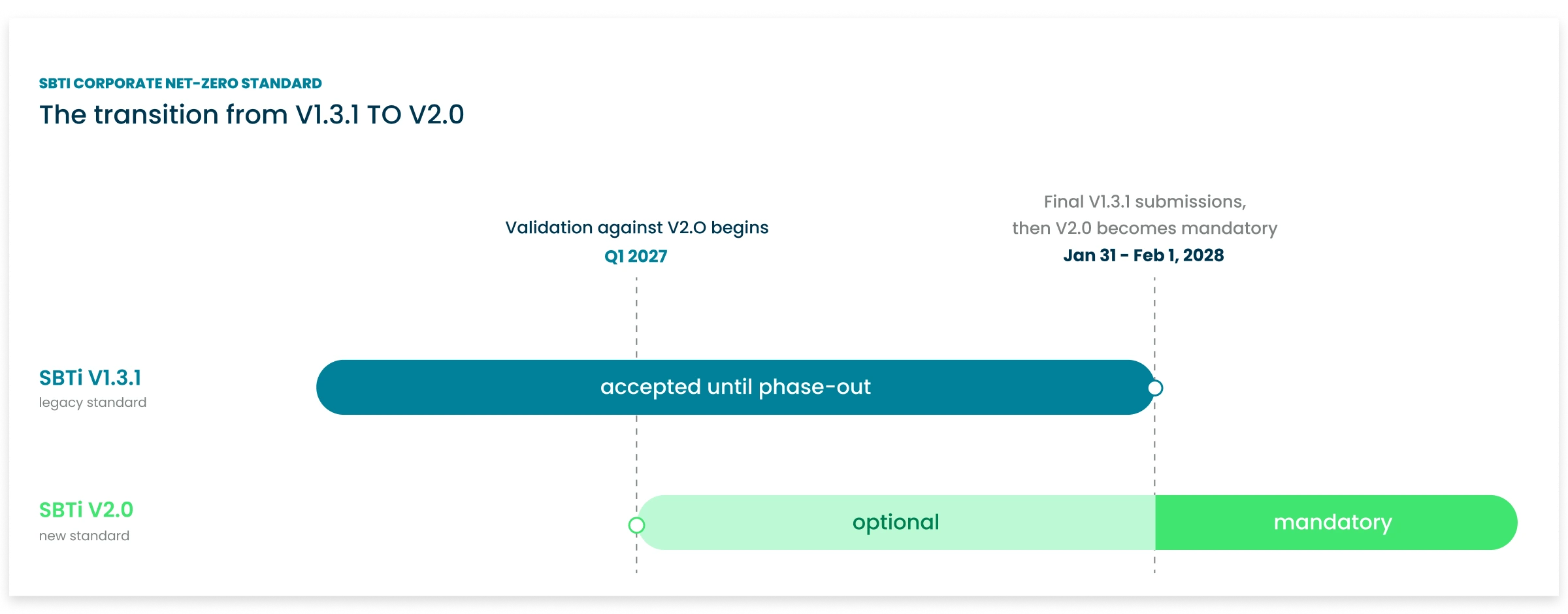
While V2.0 has been developed, it does not require an immediate transition away from the earlier standard. SBTi has established a transition period to give companies time to understand the updated requirements and prepare for their next target-setting cycle.
Key dates include:
- February 1, 2027: SBTi begins accepting target submissions under V2.0.
- Through January 31, 2028: Companies can submit targets under either V1.2 or V2.0.
- February 1, 2028: New target submissions must use V2.0.
Companies with existing validated targets should review the applicable transition and review requirements to determine when they will need to align with the updated standard.
How You Can Prepare
Here are some key steps to prepare for the roll out of SBTi V2.0:
- Determine your target-setting timeline: Review when your company plans to establish, update, or renew its targets and identify which version of the standard applies. Companies who choose to stay on V1.3.1 for their next target-setting exercise will have to transition to V2.0 during the following cycle when renewing the target. For companies with a more flexible timeline, getting up to speed on V2.0 earlier can facilitate a smoother transition during the next cycle.
- Confirm your company category: Understand whether your organization falls under Category A or Category B and which requirements apply.
- Develop and assess your emissions inventory: If you haven’t already, complete an emissions inventory covering Scopes 1, 2, and 3 with the most recent calendar year’s data. This serves as an emissions baseline and pinpoint gaps in data availability.
- Identify decarbonization opportunities: Evaluate the baseline data to determine the decarbonization initiatives with the greatest potential impact.
- Establish accountability and track progress: Assign ownership for implementation, align climate targets with business planning, and develop processes to monitor progress over time.
How Novata Can Help
Novata acts as a dedicated partner for SBTi alignment, offering end-to-end support for all undertakings involved in target-setting, from measuring emissions and determining the target to submission support and decarbonization strategy. For companies preparing for V2.0, getting these foundations in place early can make the transition from emissions measurement to target implementation more manageable.
Ready to prepare for your next target cycle?
- Get the Carbon Inventory Guide to build a baseline that holds up to validation
- Start a free five-day trial of Novata Carbon Navigator to calculate your Scope 1, 2 and 3 emissions
- Speak with an expert about SBTi target-setting and submission support
FAQ
The SBTi Corporate Net-Zero Standard V2.0 is the updated framework that sets the criteria a company’s climate targets must meet to be validated as science-based. SBTi released it in June 2026. It places more weight on how companies deliver and track their targets after setting them, and it introduces new company categories and target-setting methodologies.
SBTi validation is widely treated as the benchmark for credible corporate climate targets. A validated target shows that a company’s emissions goals are grounded in climate science and aligned with limiting global warming to 1.5°C. The framework also gives companies a consistent structure for turning those goals into emissions reduction actions.
SBTi V2.0 takes effect for new target submissions on February 1, 2027, when SBTi begins accepting targets under the updated standard. From February 1, 2028, every new target submission must use V2.0.
Companies can keep using V1.3.1 until January 31, 2028, so moving to V2.0 straight away is optional. SBTi accepts submissions under either version from February 1, 2027 until that date. A company that submits under V1.3.1 will move to V2.0 the next time it renews its targets.
Targets that SBTi has already validated stay in place until the company’s next target review or renewal, which is when they need to align with V2.0. Companies with validated targets should check SBTi’s transition requirements against their own target timeline to see when that applies.
SBTi V2.0 requires companies to publicly report their progress, along with any barriers to progress, on validated targets every year. At the end of each target cycle, companies also complete a longer report that includes a full Scope 1, 2 and 3 GHG inventory.