Resilience is all about anticipating disruption and building the capacity to adapt and thrive, even in unfavorable circumstances. Sustainability and resilience are intertwined; when you invest in sustainable practices, you’re also fortifying your business with the ability to withstand risks like climate hazards and economic turbulence.
To be resilient is to be future-ready; and in today’s increasingly volatile landscape, it’s no longer a question of if disruptions will happen, but when. A resilient business is able to turn uncertainties into opportunities to thrive, regardless of what the future holds.
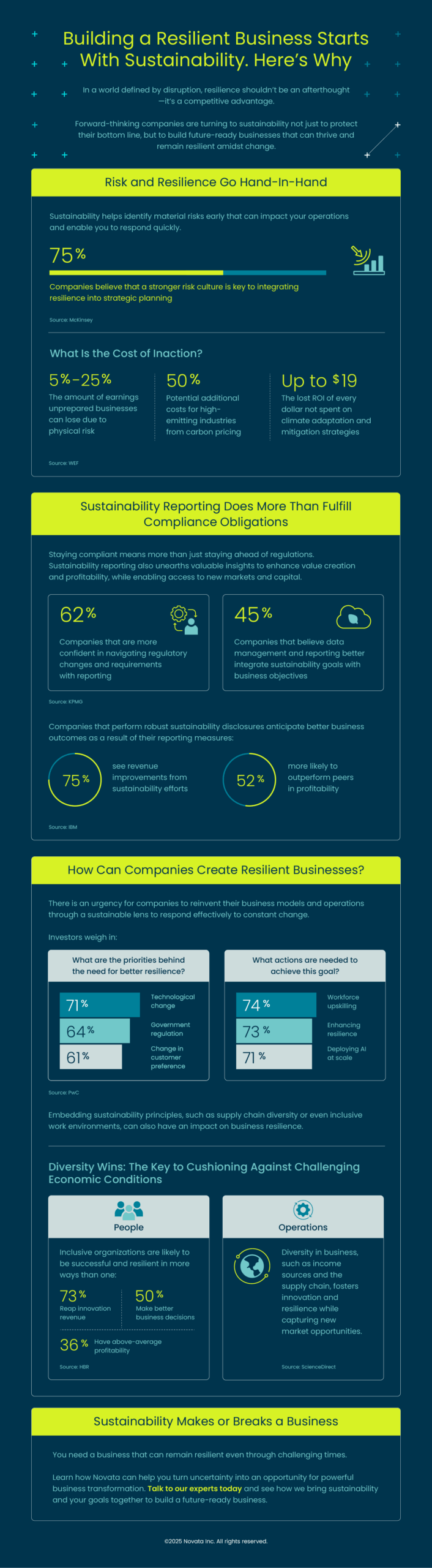
Infographic: Building a Resilient Business Starts with Sustainability. Here’s Why
How Sustainability Forges Resilience Businesses
1. Integrate Risk Mitigation For Strategic Business Resilience
The global pandemic revealed weaknesses in many organizations’ capabilities to respond to unprecedented challenges, and the lessons from those years still ring true. Risk and resilience are often considered together—a McKinsey study highlighted that building resilient businesses starts with the strategic integration of risk management, such as risk forecasting and governance.
For many companies, identifying material sustainability risks is a holistic way to pinpoint financial and impact-related issues that can affect your operations or industry. Businesses unprepared to address potential disruptions will find themselves spending more resources on recovery, rather than rapidly capitalizing on new opportunities that arise from changing conditions. Effective risk mitigation also does more than help firms withstand unforeseen disruptions; it fosters a culture of innovation, prompting organizations to rethink traditional systems and embrace more agile solutions to ensure a competitive, yet resilient business.
2. Turn Sustainability Regulations Into a Competitive Edge
Despite pauses to mandatory sustainability reporting in the EU and significant overhauls to key reporting frameworks, there is no room for complacency. Even with these temporary setbacks, the push for climate accountability is set to strengthen globally.
Staying compliant means more than just staying ahead. Forward-thinking companies that are proactive in their sustainability disclosure efforts can not only safeguard themselves against noncompliance penalties, but also have the data-driven insights to enhance value creation. Moreover, early action signals a genuine commitment to sustainability to global investors and partners, enabling access to markets that emphasize sustainability as a business prerequisite, such as the European Union. While laggards are facing costly retrofits to keep pace with new regulatory requirements, companies with established reporting processes are likely more confident and prepared to navigate these shifts, leading to better resilience and stability in the face of regulatory change.
3. Do More With Less Through Sustainable Operations
Most organizations view sustainability as a means to optimize systems for maximum productivity and profitability. However, incorporating environmental and social dimensions into operations is more than just a cost-cutting measure.
Changes such as implementing circular economy practices or diversifying supply chains help organizations be agile and adaptable in fluctuating markets. Sustainable practices are also a strategic play—these efficiencies can provide crucial buffers during economic downturns or resource constraints, ensuring that your business stays on course during times of disruption.
4. Weather Market and Economic Changes Through Sustainable Business
The World Economic Forum reports that the impact of resilience (or lack thereof) on annual GDP growth is 1 to 5% globally. Resilience thrives on diversity, and sustainability introduces new revenue streams and value-creation pathways for economic strength.
Companies embracing sustainability can attract capital from value-aligned investors and tap into the eco-conscious consumer market. By reducing the reliance on a sole or legacy revenue source, companies can cultivate adaptive business models that cushion against market volatility and bolster growth, even in challenging economic environments. But it’s not just about market diversity—internal diversity matters too.
Research from McKinsey has also shown that there is a strong correlation between diverse executive teams, integrated diversity, equity, and inclusion initiatives, and better financial performance, leading to more resilient, agile organizations.
5. Innovate for a Smarter, Resilient Future
Incorporating a sustainable focus usually presents new business challenges for many organizations, encouraging a thorough reflection of how they can reconcile economic growth with sustainable practices. But companies willing to embrace this transition can leverage sustainability as a catalyst for powerful innovation and competitive differentiation. Imagine regenerative resource strategies, new offerings, and visionary breakthroughs that can both benefit your business and the planet. Sustainable businesses are not only growing their bottom line—they are also future-proofing their operations for long-term business continuity in mind.
The Path to Resilience Starts With Sustainability
Resilient businesses don’t just survive disruption—they evolve through it. As sustainability reshapes risk, regulations, and the way business is done, forward-thinking companies will need to leverage sustainable practices to turn today’s challenges into tomorrow’s strategic edge.
Start a conversation with a Novata expert today to learn how we can help you bring together sustainability data, expert insight, and action to build a future-ready, resilient business.